Games
September 30th, 2026
What is it?
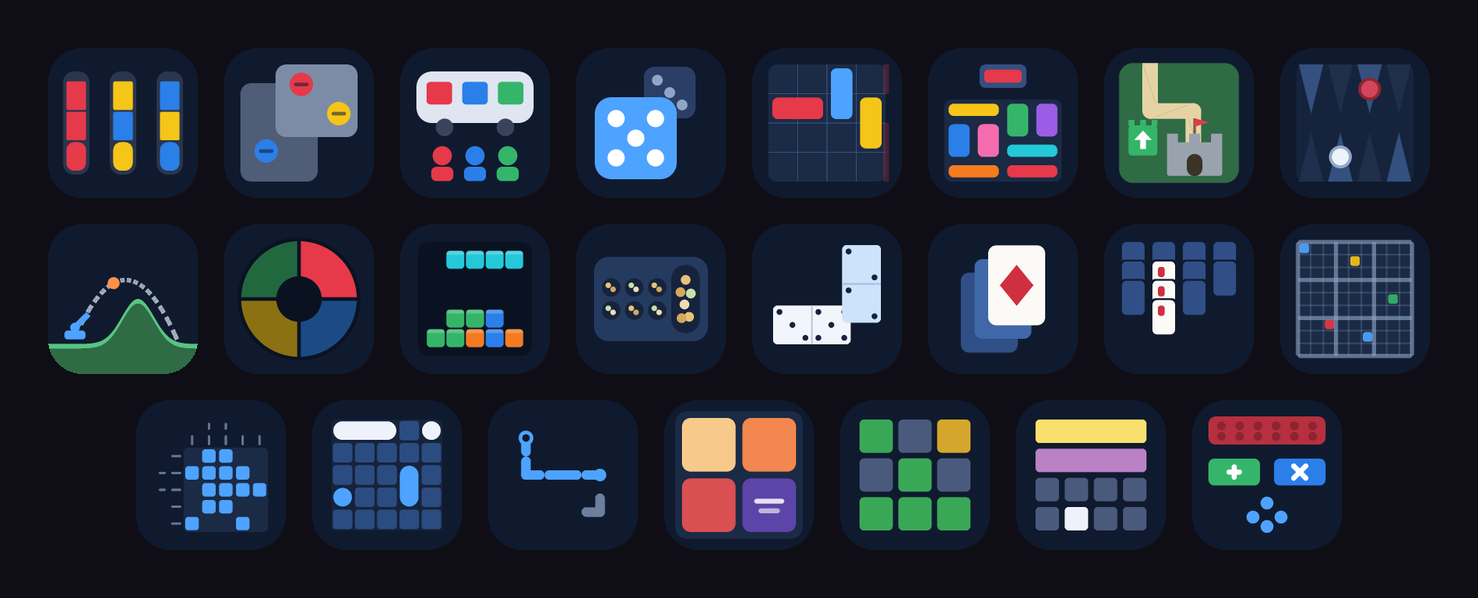
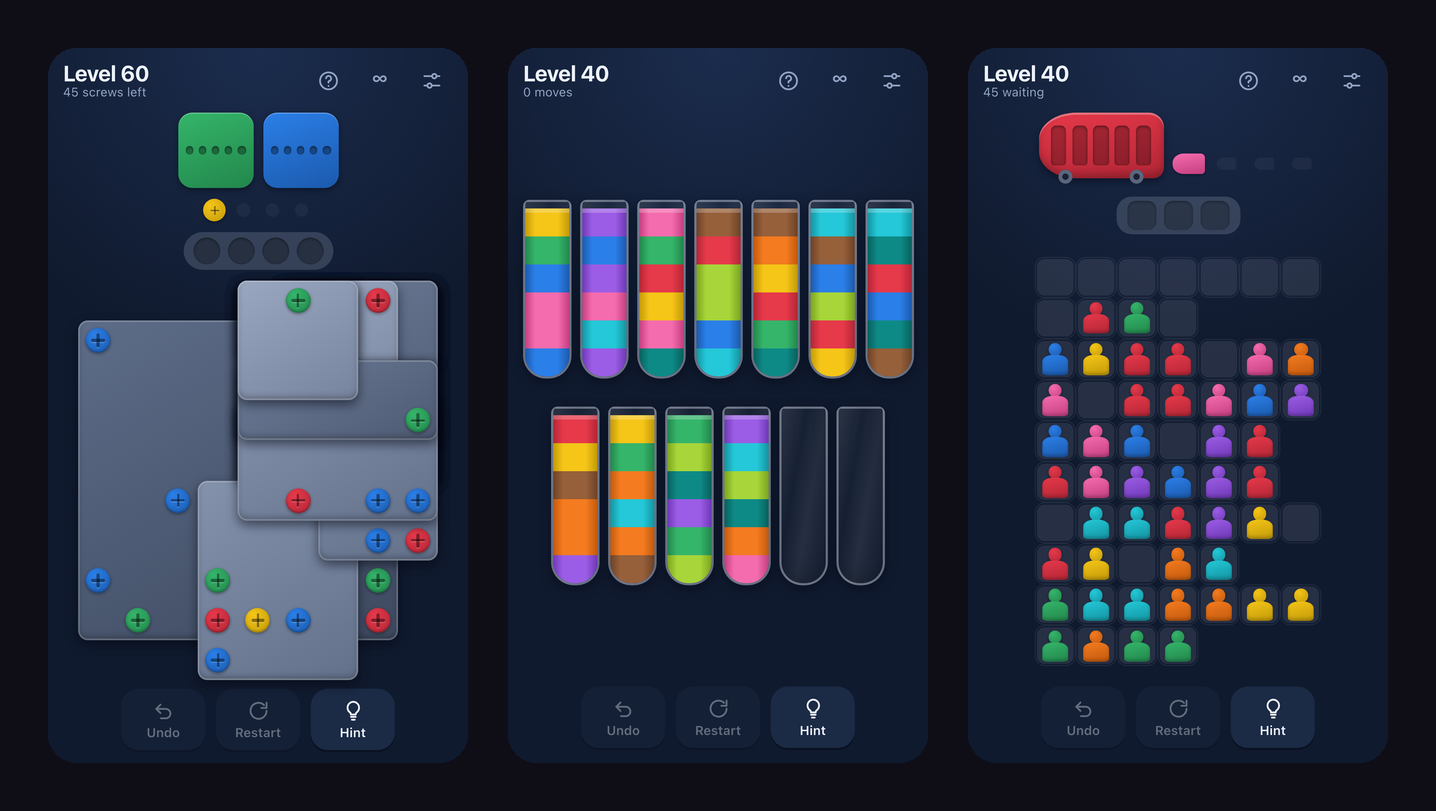
games.thomaskfisher.com is a collection of twenty-three mobile games that I rebuilt for my wife so she could play them without the ads. It started with the puzzle games she already played on her phone (Color Sort, Screw Land and Bus Jam) and then kept going, through Solitaire, Sudoku and Wordle, all the way to Backgammon, Tetris and a tower defense game that I turned into a puzzle somewhere along the way.
There are no ads, no accounts, no coins and nothing to buy. Every game installs to your home screen like a normal app, works on a plane, and keeps your progress on your own phone instead of on somebody's server. The first commit was on September 2nd and the twenty third game went up on the 26th, so the whole thing is less than a month old, which says more about the tools I built it with than it does about me.
Why did I build it?
My wife likes puzzle games, and the puzzle games she likes are not really built for the people playing them. You finish a level and watch an ad. You lose a level and you are out of lives, so you can either wait or pay to keep going. There are coins, and boosters you buy with the coins, and a level 80 sitting there locked so you know what you are missing. All of it exists to create pressure rather than play, and somewhere underneath it there is a perfectly good puzzle that is honestly pretty fun.
The part that bothered me most was that some of the levels could not be won. The originals ship dead ends, and when you are out of moves on one of those there is no way to tell the difference between a hard level and a broken one, other than spending a booster to find out (which is, I assume, the point). So I asked myself a fairly obvious question for a software engineer to ask: how hard could it be to just build her the game? The answer turned out to be "not very," and then I couldn't stop.
What does it do?
You open games.thomaskfisher.com and get a grid of icons. Tap one and you are playing; there is no sign up, no tutorial level, and no splash screen. You can star the ones you play most to pin them to the top, and the little badge on a card means it is meant for two people sharing one phone.
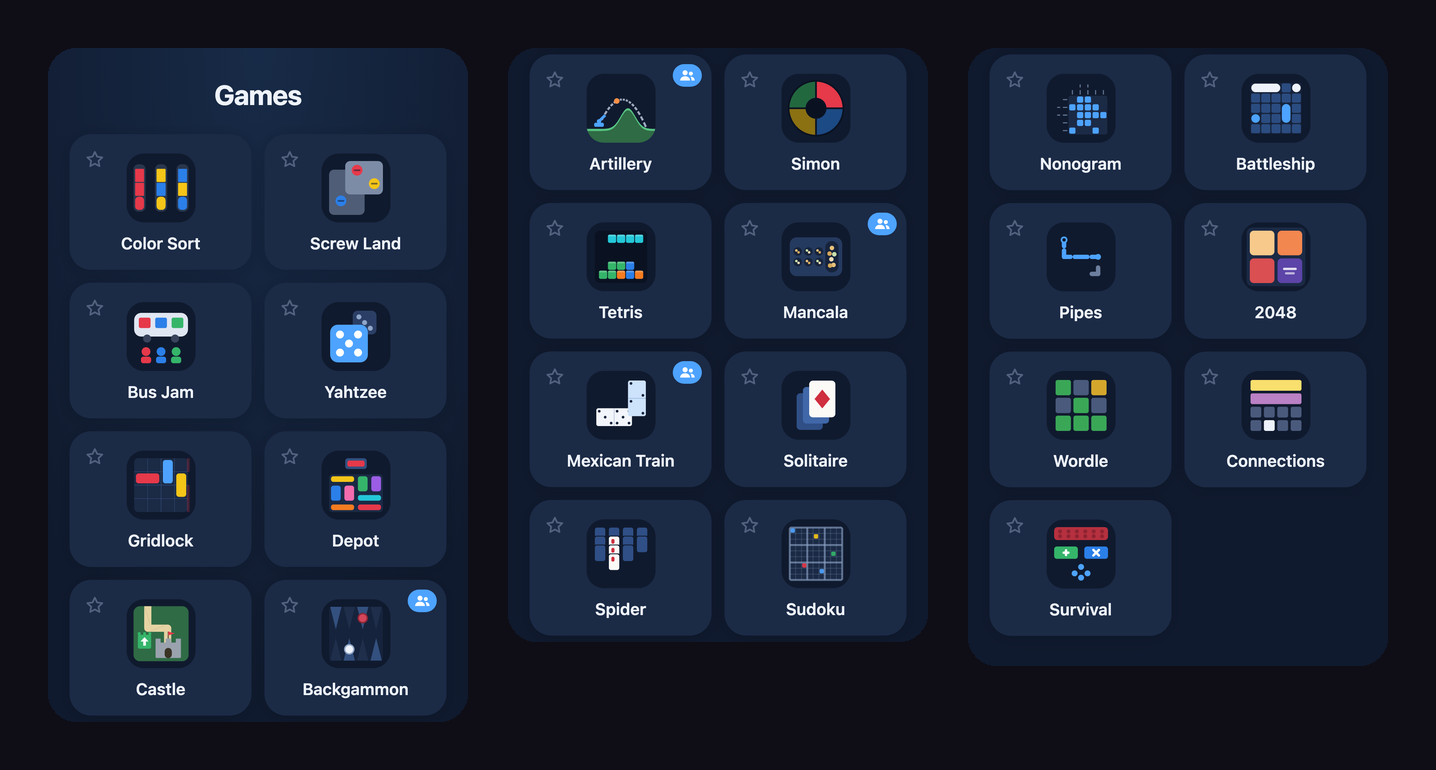
All twenty-three on one page. Sixteen are puzzles, and the other seven are the ones I kept building after I ran out of excuses.
No ads, no lives, nothing to buy
Every game follows the same short list of house rules, which I wrote down on the first day so I would never have to argue with myself about them again. No ads in any form. No in-game currency, no power-ups for sale, and no lives or timers that make you wait to keep playing. Undo is unlimited and the hint button is free, because once you can take back any move there is nothing left for a power-up to do. Nothing is ever locked either; there is a box in settings where you can type in any level number and just go there.
Progress is saved on the device after every move, not just at the end of a level, so if you close the app halfway through a board it is right where you left it when you come back. There is also a backup code you can copy out of settings, which is how you move your progress to a new phone without me needing an account system (or a database, or a privacy policy).
Every level can be won
This is the promise the whole collection rests on. Levels are generated from a random seed, so they never run out, and every puzzle level is handed to a solver before you see it. If the solver can't finish a board, the board gets thrown away and you never know it existed. The same solver powers the hint button, so a hint is always a step along a line that actually wins rather than a guess.
Difficulty is measured instead of assumed. For most of the puzzles the generator plays each board over and over like a reasonably careless person would (i.e. someone on the couch, not a computer running a search) and counts how often that player paints themselves into a corner. That number is what gets matched to the level you are on. Gridlock, the sliding car puzzle, gets something better: its boards are small enough to search completely, so when it says a park needs nineteen slides that means no eighteen-slide solution exists anywhere.
Every game explains itself once
The first time you open a game you get one short illustrated sheet, usually three steps long, and then it gets out of the way forever (it is still behind the question mark if you need it). The rule I eventually landed on is that the sheet only names the things you would lose a level for not knowing, like the fact that Screw Land is over the moment its tray fills up. Anything you can figure out by tapping doesn't go on the sheet.
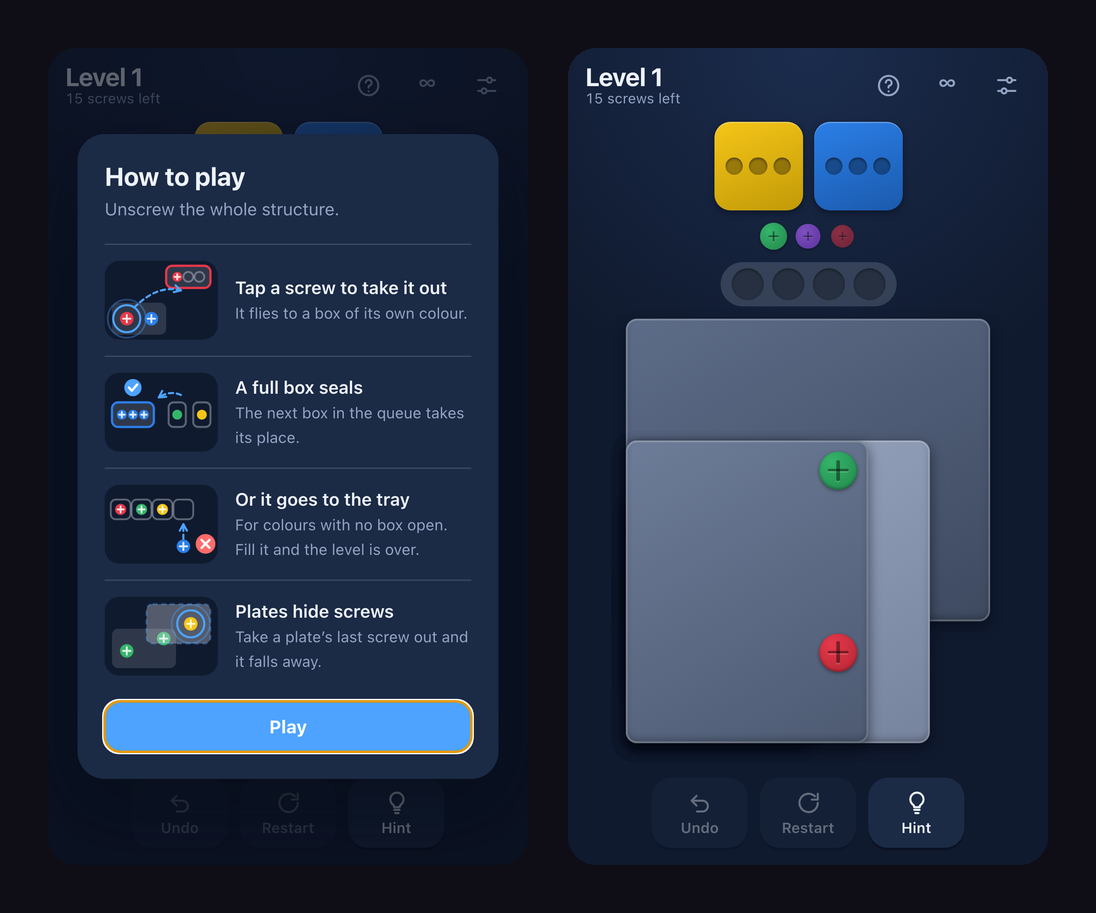
Screw Land explaining itself, then the board it was explaining. That fourth step was supposed to cost me a level before I let it on there.
Some of them aren't puzzles at all
Seven of the twenty-three break the house rules on purpose. Yahtzee has no undo and no restart, because the dice are decided before you roll them and being able to rewind a throw would just be reading the answer. Instead every box takes two taps to fill, since what undo was really protecting you from was the stray thumb that writes a zero in your Yahtzee row twenty minutes into a good game. Backgammon, Mancala, Mexican Train and Artillery are for two people passing one phone back and forth, so the hint is gone (it would be an engine sitting at the table playing for one side) and in most of them undo only lasts until you hand the phone over. Backgammon also flips the whole board around at the end of every turn, so neither player ever has to read it upside down.
Turning games into puzzles
A few of the originals I liked were not puzzles to begin with, they were tests of how fast your thumb is. Survival started as a game where your squad runs at a wall of gates and you swerve between them, and it is now a route you plan across a board you can see all at once. Castle is tower defense, except you place all of your towers before the wave starts and then press Go and watch whether you were right. Depot is a mashup of Bus Jam and a parking lot puzzle, which I am fairly sure doesn't exist anywhere else (I didn't look very hard).
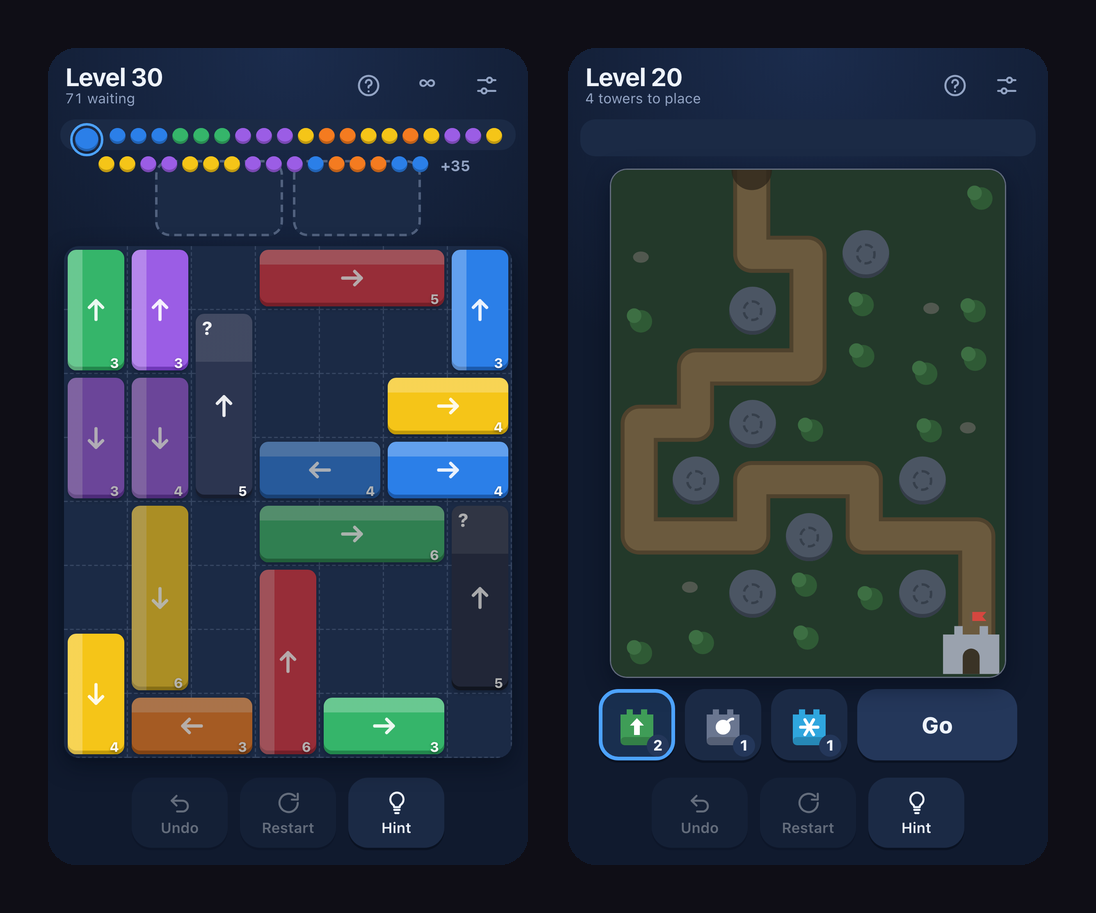
Depot on the left and Castle on the right. Nobody asked for either of these, which has never stopped me before.
What have I learned?
AI tools have moved the bottleneck from building things to deciding what to build.
- Like KeepTrack, nearly every commit in this project was made with Claude Code, and twenty-three games in under four weeks is not a pace I could have kept by hand on nights and weekends.
- What actually slowed me down was having to explain the same decisions over and over, so I wrote the house rules into one document that every new game starts from. After that, starting a new game mostly meant describing the core mechanic and deciding what to cut.
- The document grew every time something went wrong. Depot's first rules sheet had a twenty-three word caption carrying two rules at once, and the fix was not just a shorter caption but a table of how long every piece of copy is allowed to be.
Measure it before you trust it.
- The difficulty scores for the first two games were both off by about an order of magnitude, which produced a difficulty curve that was basically flat.
- In Depot my first guess about what made a board hard was not weak, it was backwards. I assumed a crowded lot was harder, but six buses trapped a careless player 19% of the time and eighteen trapped them 91%. More buses just meant more chances to park one in the wrong place.
- One small change to Screw Land's difficulty took level 20 from 400 milliseconds to generate to 34 seconds. Nothing about the level looked any different; you would just be sitting there waiting for the board to show up.
Don't sell something to someone who is already using it.
- Three days in, every screen was still pitching my wife on the games: "No ads. No accounts. No tracking." on the launcher, a list of promises on every rules sheet, and a paragraph after every lost level reassuring her that the board really was solvable.
- She did not need convincing, she was already playing, and all of it was text standing between her and the game. Cutting it is the change that made the whole thing feel calm.
Passing tests are not the same thing as working (I keep relearning this one).
- Tetris went live with a broken icon because the icons were regenerated after the build instead of before it, and nothing anywhere complained.
- Mexican Train's privacy curtain, the screen that hides your tiles when you pass the phone, reported itself as hidden while still showing the next player your whole hand.
- And on September 28th, nearly a month in, I found out that every game was completely silent on an iPhone. The sound setting just didn't do anything.
How is it going?
I never planned on anyone but my family playing these, and I have never posted about them anywhere. But on September 20th I noticed that people other than the family were opening them, so I added the smallest counter I could think of that didn't track anybody. Each phone adds one to today's number for each game it opens, at most once a day, and that is all the database holds: a number per game per day. There is also a switch that keeps my family's phones out of the count.
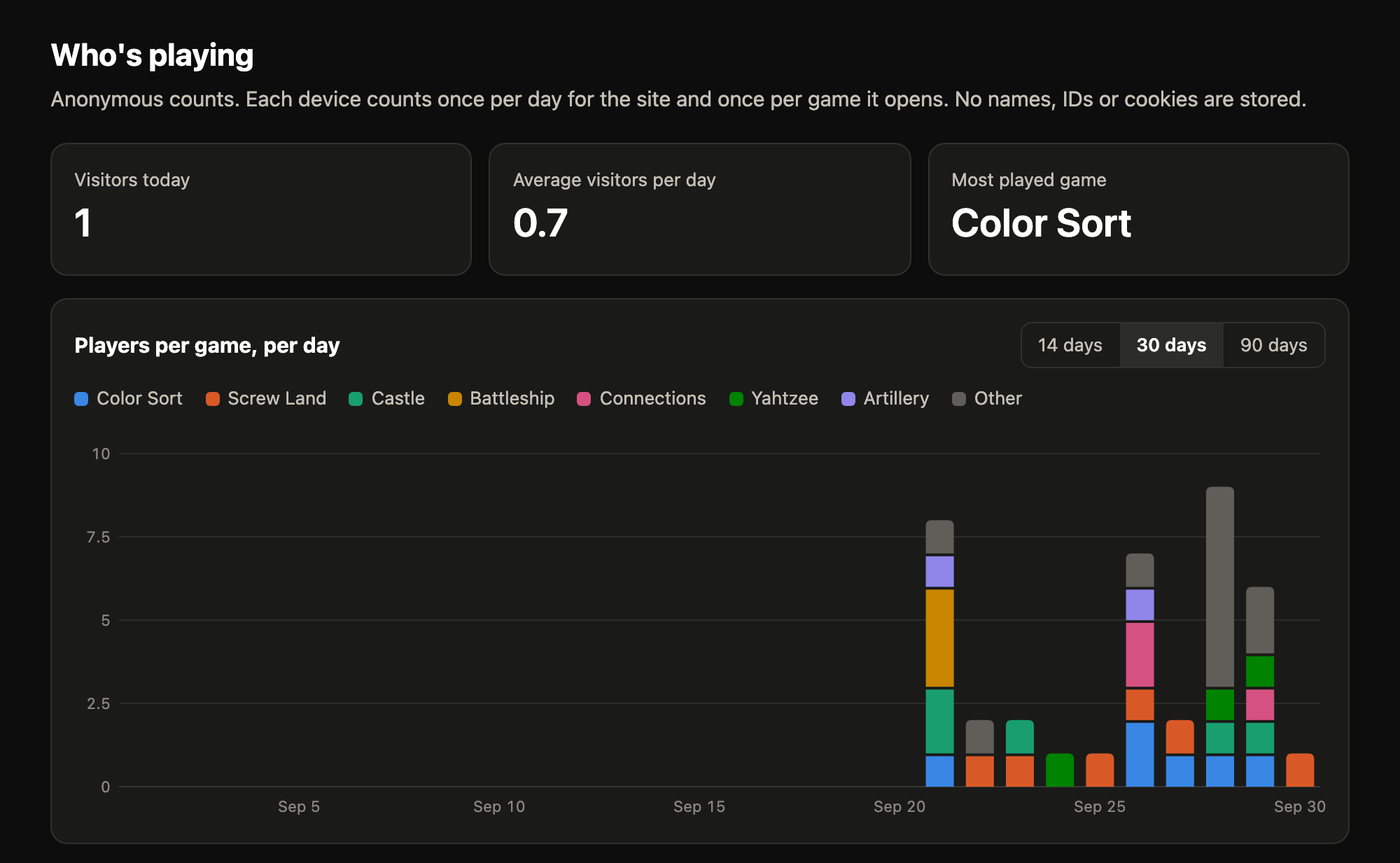
The stats page in its entirety. Someone out there opens Screw Land nearly every day, and I would love to know who you are.
In the ten days since, the counter has recorded twenty visits in total, which works out to about two people a day. The most played games are Color Sort and Screw Land, which are the two I built first for my wife, so at least the strangers and my wife have the same taste.
Did I make any money? No, and that one was on purpose. Did I build a gaming empire? Also no, the numbers are right there. Did anyone ask me for Battleship? Definitely not. But my wife can play Screw Land now without sitting through a single ad, and every level she gets stuck on is one she can actually win. That was the whole point.